

(Disclosure: this is an expanded version of a review originally written on Letterboxd a couple months ago: https://letterboxd.com/frdougal9000/film/the-crab-with-the-golden-claws-1947/)
One of my earliest memories is reading the Tintin book Prisoners of the Sun in my family’s living room. It must have been the middle of the night (or whatever that would’ve been to a 4 year old), and it was one of many scenes where Captain Haddock was getting spat on by a llama. Ever since then, Tintin‘s always been in my life somehow. I used to read the comics all the time during primary school, I’ve played the video game adaptation of Steven Spielberg’s excellent Secret of the Unicorn film countless times, and one of my favourite books is Harry Thompson’s biography “Tintin: Hergé and his Creation”.
In one of the later chapters, Thompson discusses the history of Tintin‘s various film and TV adaptations. Since the book came out in 1991, it primarily dives into the Belvision animations; the notorious Hergé’s Adventures of Tintin TV series and the Temple of the Sun & The Lake of Sharks movies. But it also discusses other productions such as the two live-action films from the early 60s, as well as animated projects that were lost at the time of the book’s publication.
Among these was a stop-motion adaptation of The Crab with the Golden Claws, directed by Claude Misonne and given one (maybe two) theatrical screenings in 1947. It was the earliest animated take on Tintin, the earliest Tintin film of any kind, and one that I’ve always been curious about watching. Despite the movie’s missing status according to Thompson’s book, that situation has long since changed with it being found and made easily available for viewing.
Whether on DVD or through the most casual YouTube search, you too can watch Crab with the Golden Claws, and I decided to finally take that chance one September morning. I’d previously glanced through the opening, so I wasn’t sure what to expect going in. Initially, I was quite charmed by the artstyle, and how the sculpted faces with their painted eyes and eyebrows manage to convey that clean expressive look of the Tintin stories. Haddock’s distressed drunken state is particularly well defined with his big eye bags and shaggy hair. At one point, he made a open-mouthed smile and for a moment he looked like he leapt from Hergé’s pen into a puppet!
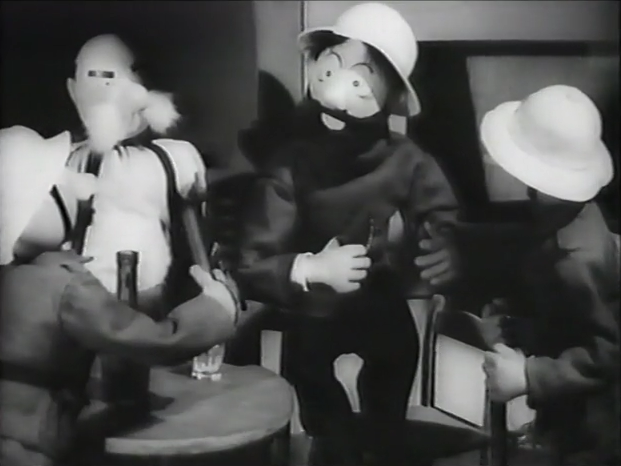
As a series that primarily exists in 2D, I’m not used to experiencing Tintin through 3D, and the handful of examples I know utilize the photo-realistic look most commonly associated with the Spielberg film. While I feel that movie used its look to great effect, keeping the motion-captured performances grounded while allowing for stunningly crafted set-pieces and cinematography, the other adaptations missed the appeal of the comic art for an uncanny artstyle. So it was pleasing to see a more literal translation, with plenty of appealing characters and (admittedly tiny) sets.
What also surprised me was realizing this movie is a very close retelling of the source material. Nearly every scene is preserved with its dialogue intact, presented in the same order as the book, right down to minor bits of character interactions and physical comedy. As one of the more popular books, Crab has been adapted into animation plenty of times; through the Belvision series, the Ellipse-Nelvana Adventures of Tintin cartoon from the early 90s, and the Spielberg movie.
But it’s always been changed in some way to suit the needs and restrictions of the adaptation. The Belvision and Nelvana shows added new scenes and removed others (though the latter is considerably more faithful), while the Spielberg film combines Crab‘s set-pieces and overall narrative flow with the underlying mystery of the Unicorn books. That’s not to say these changes are inherently bad, just that the stop-motion film is as close as you’ll get to experiencing the original book through animation.
For the most part, anyway. There are two major scenes excised from the book, and I feel their removal harms the film. The very ending of the story is gone, which originally tied everything up and ensured that Haddock is now a lifelong friend of Tintin’s. Although the movie ends with its mystery resolved, the characters aren’t given the time to breathe afterwards and things conclude on a rushed note. (The fact that Bunji Kuraki, the Japanese detective kidnapped at the start of the film, is seen lurking behind the main cast in the finale makes me think they had a plan to shoot a more conclusive ending where his fate was explained amongst other things, but either didn’t or couldn’t.)
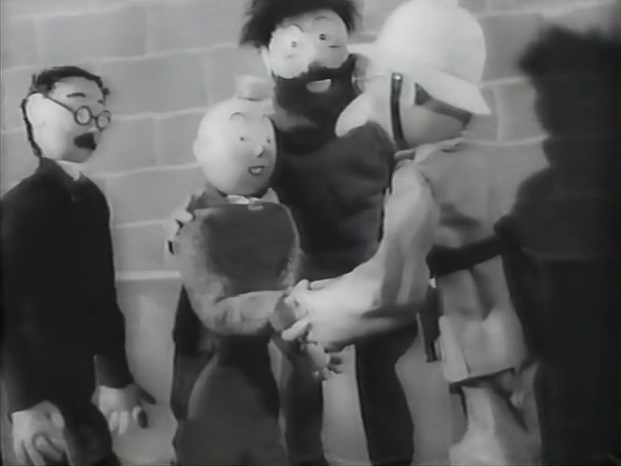
The other scene is the fight against the desert bandits, who end up fleeing from the sheer power of Haddock’s enraged vocabulary. While not as important to the overall story, to the extent that I didn’t even notice its absence initially, I think it’s telling to the constraints of the animated production. It has a lot of characters and moving parts, and I suspect that the director didn’t want to animate any more than they had to.
That’s a strong assumption to make, but if the movie’s opening credits are correct, director Claude Misonne seems to have also been the sole animator on this picture. Animating entirely by yourself is a lot to ask out of anybody, especially here considering the film’s hour-long runtime, and there’s plenty of shortcuts taken to reduce the workload.
Characters often teleport to wherever they need to be between shots. A good chunk of the physical comedy is left off-screen or animated to a bare minimum. Scenes taking place at the docksides use a lot of stock footage of real-life docksides where you don’t see the characters. Anything involving miniature vehicles like boats or planes are filmed rather than animated, such as the extended sequence of Tintin and Haddock being attacked on a lifeboat by a seaplane which they soon manage to hijack.
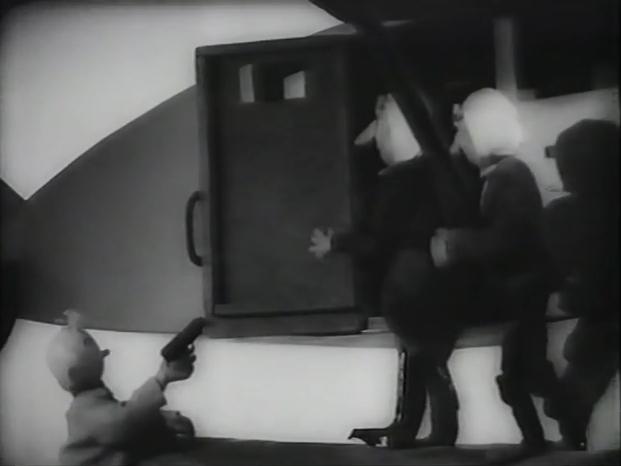
I don’t mind any of these shortcuts. I like seeing between the gaps and figuring out how they tried to make all these techniques work together in any cartoon, and they lend the movie something of an experimental vibe at times that can be rather endearing. All those scenes of the lifeboat/seaplane sequence look like they’ve been filmed in someone’s bathtub, which I mean in the kindest way. But those shortcuts also result in a movie that feels a bit disjointed, where important visual information is left uncommunicated and where the slapstick that makes Tintin a hoot to read is left lacking.
In the end, it’s hard to escape the feeling that this could’ve been better. I wish the filmmakers had more time and resources to bring the entire story to life, because this makes for a potentially solid way to experience the source material for people with reading difficulties. I certainly wish it had a better soundtrack, rather than the orchestral underscore which noodles away indifferently to whatever’s happening like some generic wartime newsreel. Perhaps it was a miracle this even got finished at all, considering that the thing was allegedly screened once or twice before the movie was seized in the wake of its producer Wilfried Bouchery declaring bankruptcy and buggering off to Argentina.
For what they managed to create, there’s a fair bit to like and it’s always interesting to see how a work gets translated into a different medium. If you decide to watch it, I hope you get more out of it than I ultimately did, nice as it was to finally experience it for myself.
WEBSITES AND SOURCES:
Tintin: Hergé and his Creation (1991), by Harry Thompson
A fan page briefly discussing the film’s history and production, though I wasn’t able to get much from the sources it also provided – https://www.tintinologist.org/guides/screen/crab1947.html
Special thanks to Mazinkaiser from the Hardcore Gaming 101 Discord server for proof-reading and providing feedback for the article.
Super special thanks to Eliza “Duck Twacy” Herndon from the World Animation Discord. I’d written part of this article and wasn’t too confident in it, but her encouragement pushed me to keep going until I managed to finish it.
FrDougal9000 writes for hardcoregaming101.net as Apollo Chungus. When he isn’t writing about video games, he is cultivating his love of animation that’s only increased over the last few years as he’s explored the wide, weird and wonderful world of the medium.