
I was putting together the next instalment in my collections of mini-reviews for films I saw in 2025, which was going to be themed around American animated musicals. However, I realized that I’d written so much about Shinbone Alley that it made for a very unbalanced article, compared to the couple of paragraphs I spent discussing the other films. So it seemed a better idea to take my writings on this movie and put them in their own article. It’s not a film I like very much, but it’s certainly one that made me think a lot and I felt it was worth posting about.
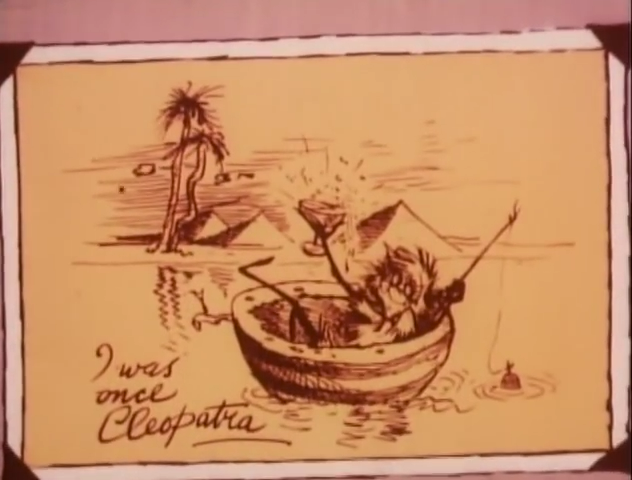
I first heard about it some years ago when looking into John David Wilson, who directed the pretty funny opening sequence to Grease with the caricatures of the main cast, and liked its ragged sketchy look. To my surprise, turns out that this is an adaptation of a musical by the same name, which itself is based on Don Marquis’ archy and mehitabel stories from New York’s Evening Sun newspaper. (Those stories often featured illustrations by George Herriman of Krazy Kat fame in collected releases, which explains why the film has a sequence rendered entirely like Herriman’s art).
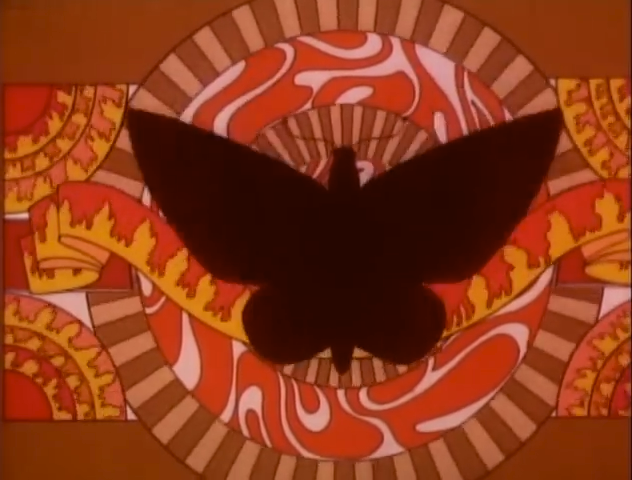
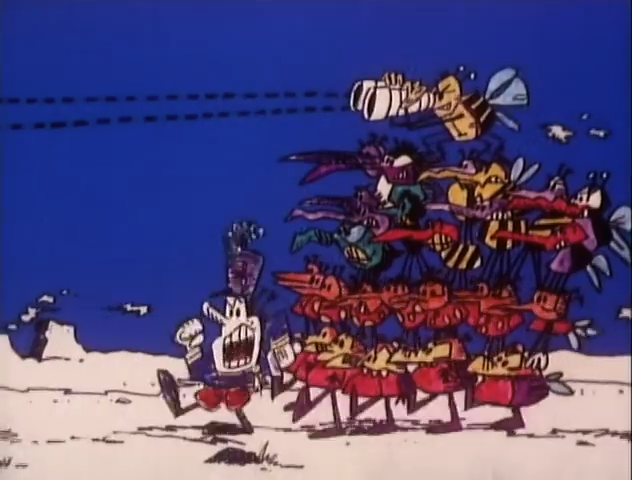
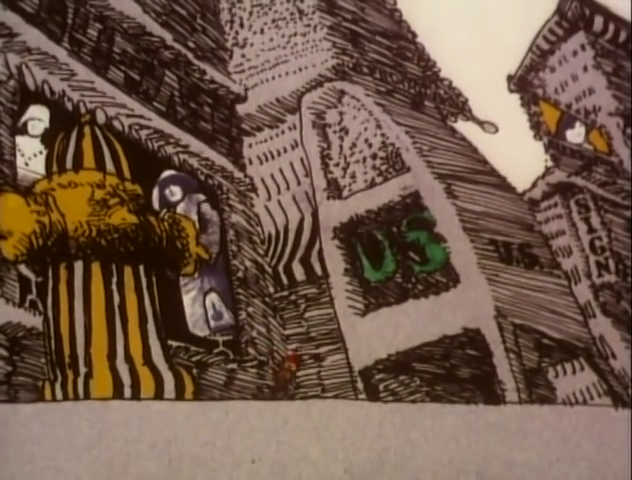
Makes sense that for a movie with such a strange trail of works behind it, Shinbone Alley ends up being pretty strange all round. In a way, I rather like that strangeness, and how it reflects in the overall picture. The backgrounds are quite appealing in their messiness, getting across the grit and dirt of the big city. There’s a couple of scenes that liven things up with a complete shift in art direction, such as the “insect revolution” sequence which takes on Herrmian’s style and the Moth song sequence that utilizes some striking psychedelic imagery.
I was most struck by how it’s a musical utterly full to bursting with songs. Unlike animated musicals that I’ve seen, there’s a new tune every couple of minutes. It’s a nice change of pace in one sense, but also something of a problem because I don’t like most of the songs. Maybe it’s the result of there being so many songs, but they’re nearly all these rambling pieces where the lyrics and melodies are so clumsily tossed off without much thought.
There’s one or two songs that do a decent job at getting across characters and their relationships through the music, such as Mehitabel’s recurring “Toujours Gai” bit that sums up her philosophy. The opening song, which I believe was made specifically for this version, has a nicely downtrodden quality to its chords and lyrics that grew on me. The Moth song is generally the highlight of the picture, where the words and how they’re sung by Eddie Bracken build up a compelling story about this largely off-screen incident. But they’re the exception in an otherwise wonky selection of hastily written, shallow showtunes.
It doesn’t help that the staging is often flat and static, in terms of the cinematography and character animation. While being so stage-like is understandable given its stage musical origins, it becomes uncomfortably claustrophobic with a lack of background ambience to breathe life into an otherwise empty world. Reminded me too much of Top Cat in that sense, and I can’t believe that makes at least two instances of potentially charming American alley cat cartoons strangled by dead air.
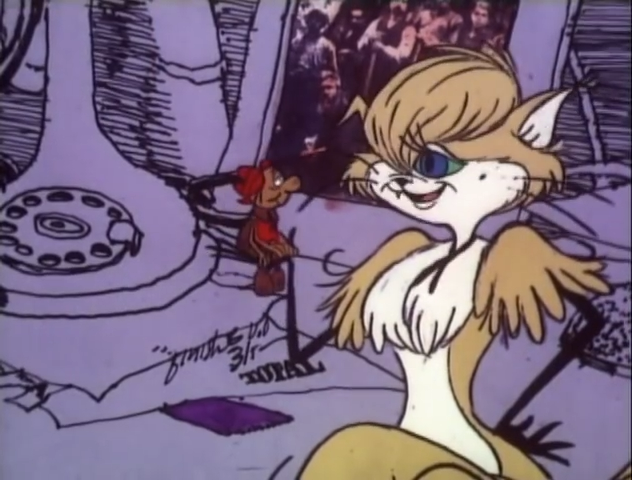
But then there are plenty of folks who sincerely like Top Cat how it is, and I think the same is probably true for Shinbone Alley. A lot of whether you’ll like the film comes down to jiving with the texture provided by the art and its cast, and I wish I jived with it more. I can’t stand Archy, he comes off as a whiny self-righteous poet who the film sympathizes with too much to play into that. Mehitabel doesn’t work for me either, mainly on account for her strange Seuss-esque design where her one unobscured eye often drifting to the middle of her head and making her look like a cyclops.
I like the other two leads a bit more. Big Bill’s already got my attention just for being played by Allan Reed, who I never realized til now has a strangely comforting voice despite playing such a jerk. Tyrone T. Tattersall’s a theatrical fop, and the animation backs that up by giving him some pantomimic movements and flourishes. But sadly they’re in and out of the film pretty quickly, leaving me with characters I find annoying or unappealing.
In terms of style or tone, I ended up thinking of two other early 70s films: The Point and Fritz the Cat. They both share a similar scraggly art direction to this movie, while The Point is a musical with plenty of abstract sequences and Fritz is set in a dingy waste-hole of a city. But beyond that, both of those films are more confident in what they want to say and are much more deft at expressing their ideas.
Fritz in particular weaponizes its rambling ugliness to compliment the bleakness of its world and characters, where everything’s messed up and the main character stumbles all over the place to find any scrap of meaning. Shinbone doesn’t have that kind of righteous anger, it’s a pantomime version of a manky world with homeless alley cats. So the handful of moments where it tries to make social commentary (primarily through Archy’s poems) are laughably toothless and preachy.
I’d rather watch either of those movies over Shinbone Alley, but then there’s one thing this movie has over them. It has two versions!
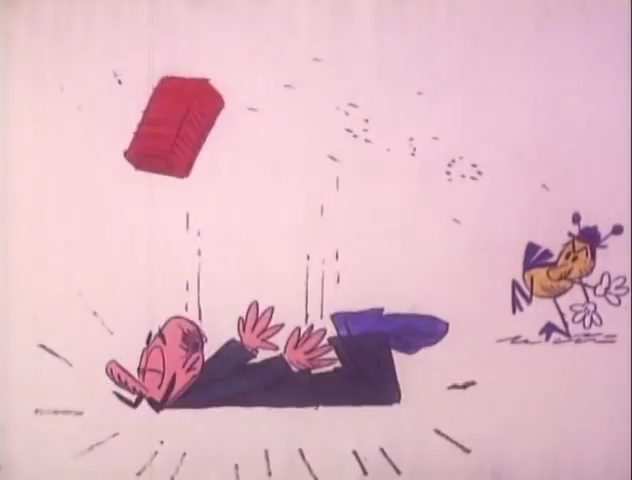
While looking into the film’s history, I found out that I watched the shorter version of the movie (running at 84 minutes) and that there’s a longer version of the movie (running at 98 minutes). A copy of the longer version was found and uploaded onto YouTube thanks to Løri’s Extras, but I wasn’t able to figure out where this version specifically came from. Every other copy of the movie I could find lists its runtime as 84 minutes.
From what I briefly glanced through of the longer version, it has a somewhat different opening, reshuffles the order of a couple scenes, has different animation for the “Toujours Gai” song, and has a couple songs that got cut. One of these is a song between Mehitabel and Bill, which shocked me considering it’s Allan Reed’s only other song in the picture. Keeping that would’ve at least given him a stronger presence.
I had an idea of doing a Cartoon Milk article comparing the two versions and seeing how they fared, but I really wanted to understand the context that resulted in these two versions existing at all. Is the longer one an earlier cut, maybe the original theatrical release, while the shorter one was a revised cut that ended up becoming the standard? I don’t know, but that might be the most interesting part about this entire film to me. Hopefully, I’ll find that out one day and tell you about it.
FrDougal9000 writes for hardcoregaming101.net as Apollo Chungus. When he isn’t writing about video games, he is cultivating his love of animation that’s only increased over the last few years as he’s explored the wide, weird and wonderful world of the medium.