
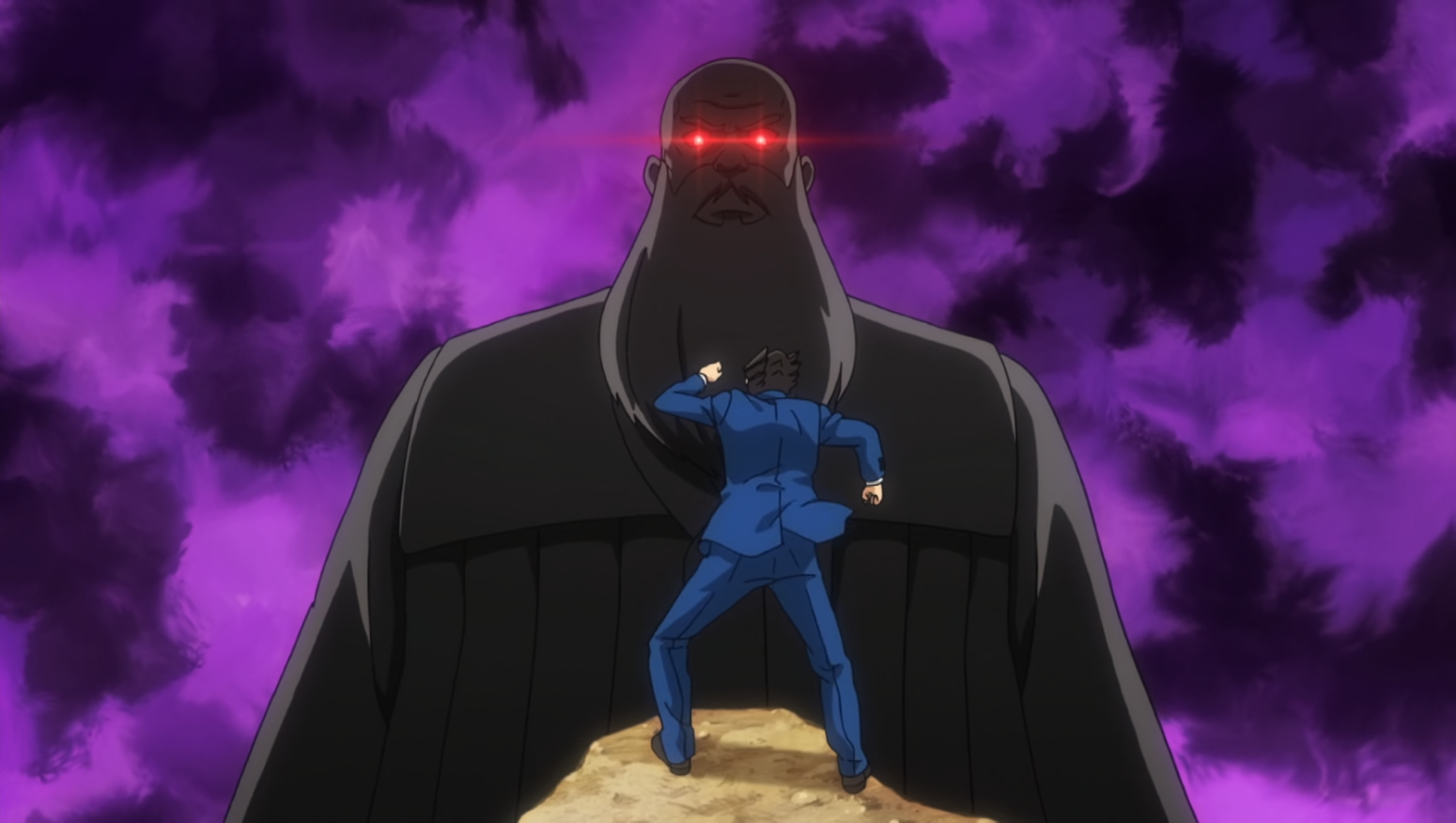
When I was a teenager, one of my favourite things in the world was the Ace Attorney series of video games. I got into it shortly after buying a Nintendo 3DS in early 2012, and it became my first love in adventure gaming (one of my favourite genres). You play as a defense lawyer who investigates murders and tries to find contradictions between the evidence and the testimonies given by witnesses. Despite that initially dry premise, it’s a gripping bunch of games with tons of personality and heart, one that would inspire many things within me that still linger.
I became interested in writing fiction for a time, it helped me to truly understand the potential of games to tell great stories, and it started the root of my appreciation for how the various aspects of a work can come together to create something unique. Although I haven’t played most of the games in years, I still think back fondly on Ace Attorney and the impact it’s had on my life.
And yet, even at the relative height of my fandom, I never got around to watching the Ace Attorney anime that aired in 2016 and 2018/19. A major part of this came down to the nature of that adaptation. I’d always hoped it would tell a series of original stories, much like the various manga and stage play spin-offs, but it was instead a fairly literal adaptation of the first three game’s storylines.
What I like about Ace Attorney is how through playing the game, you and the character you’re controlling slowly work together to solve the mystery (an excellent bit of synergy unique to the interactive nature of video games which Jacob Chapman discussed in an article shortly after the anime began airing). Losing that synergy takes away a lot of what makes Ace Attorney exciting, and something that would ideally be made up for by heightening the drama through strong visuals or direction, which I never felt the show delivered based on whatever I’d briefly seen.
I’m not knocking the show, I haven’t properly watched more than an episode of it . For many, it serves as a more accessible way of experiencing the original games’ story and characters without sinking your teeth into puzzling adventure games that each last 15-20 hours. But it didn’t seem like an interpretation of those adventures that I was interested in experiencing, so I never looked into it.
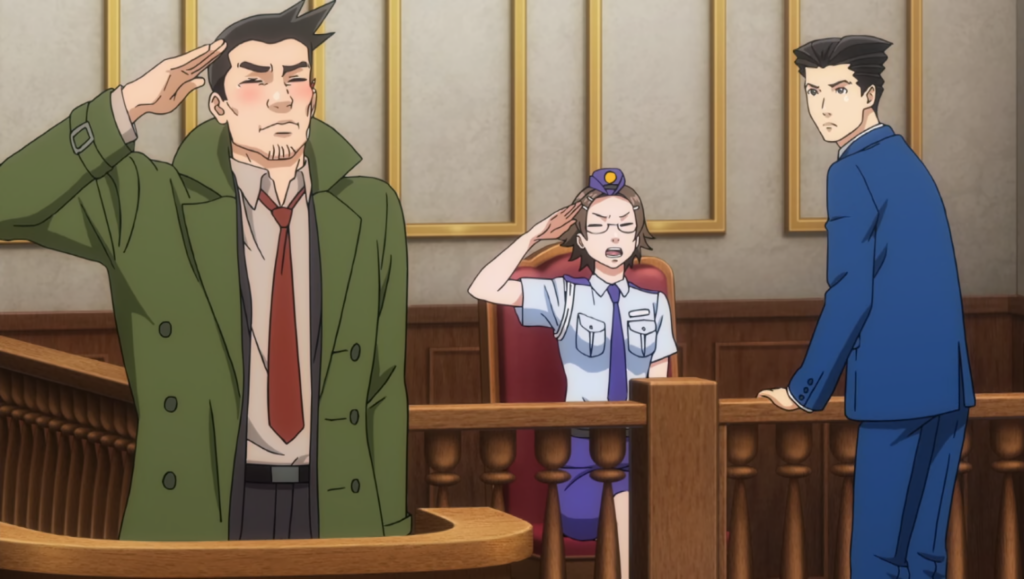
Fast forward to late 2023, when Capcom posted various episodes of the series onto YouTube as promotional build-up for the then-upcoming Apollo Justice: Ace Attorney Trilogy compilation (a hilarious name to use for the collection gathering Ace Attorneys 4, 5 and 6, but that’s another conversation). I’ve gotten into the habit of watching numerous cartoons through the YouTube app on our smart TV, so I thought it’d be a good idea to finally try something from this show since it was right there.
Instead of diving into one of the many multi-parters that comprise the bulk of the show, I went with “The Lost Turnabout”, the debut episode of the second season and the only self-contained episode available for viewing. This episode adapts the opening case from the second game Justice For All, and as I suspected, it’s a straight adaptation of that storyline. Except that it feels like you’re watching it on fast-forward, with revelations and twists coming out so often there’s no time to take anything in. Coupled with the emphasis on hysterical comic reactions from characters and a somewhat irritating English dub performance, it made for an exhaustingly breakneck watch.
Knowing the story pretty well, I tapped out a few minutes before the end and never made an attempt to watch any of the other available episodes. That’s still the case, even as I’ve generally gotten better at watching more long-form shows in recent years. At most, I might be tempted to look into the couple of original stories they made for the second season and see how they fare, but I otherwise have no plans to watch more of the Ace Attorney anime.
That said, I was impressed by one aspect of the episode, and that’s where the episode is placed in the overall broadcast of the show.
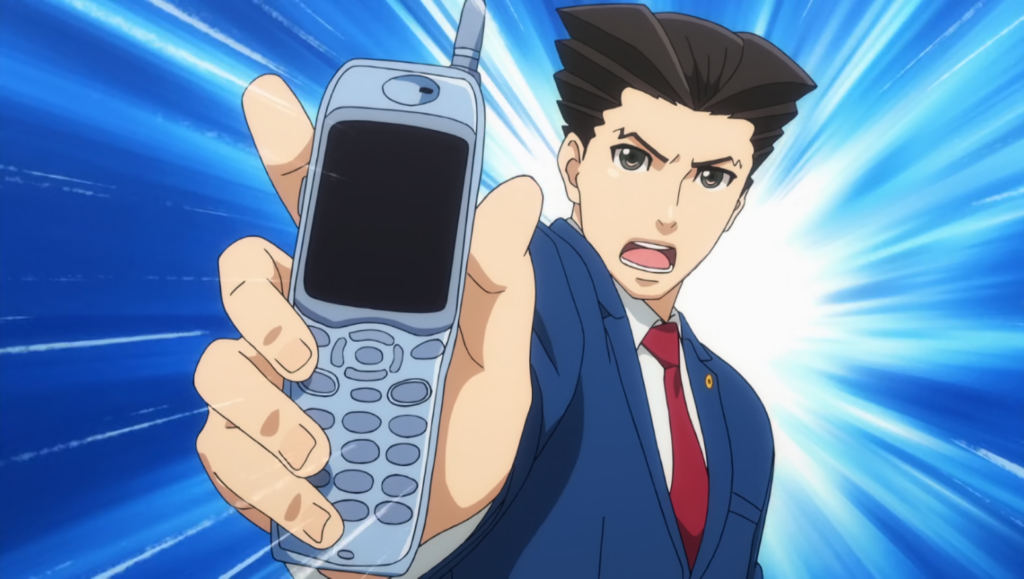
To give some background: each Ace Attorney game is made up of four to five episodic cases that eventually culminate into an overarching story. The Ace Attorney anime was produced as two seasons; the first airing in 2016 and the second through 2018/2019. The first season adapted most of the cases from the first two Ace Attorney games, while the second season adapts all of the cases from the third game along with inserting some brand new stories.
The show adapts the cases in the order they originally appeared, with two exceptions. The first is the complete absence of “Rise from the Ashes”, a brand new case made exclusively for the Nintendo DS port of the original game. (I could be cheeky and joke that this would’ve required an entire season of its own, given how notoriously lengthy that case is. But I won’t.)
The other exception is “The Lost Turnabout”. As mentioned before, it was the opening case for Justice For All, but it was instead pushed forward to act as the opening episode for the second season. It’s the only major shift in the placement of these cases, and I think that’s because of how this case is constructed in relation to its video game origins.
Every Ace Attorney game begins with a short opening case that gives you the general gist of what you’ll be doing in these things, placing you right into the courtroom where you’ll be cross-examining witnesses and contradicting their testimonies with evidence or other statements. It provides you with a brief flavor of Ace Attorney’s gameplay, tone and style, enough that it will hopefully entice newcomers and bring fans up to speed if they haven’t played one of these in a while. Doesn’t matter if you’re playing the first Ace Attorney or the twelfth, you’ll understand what to do before too long.
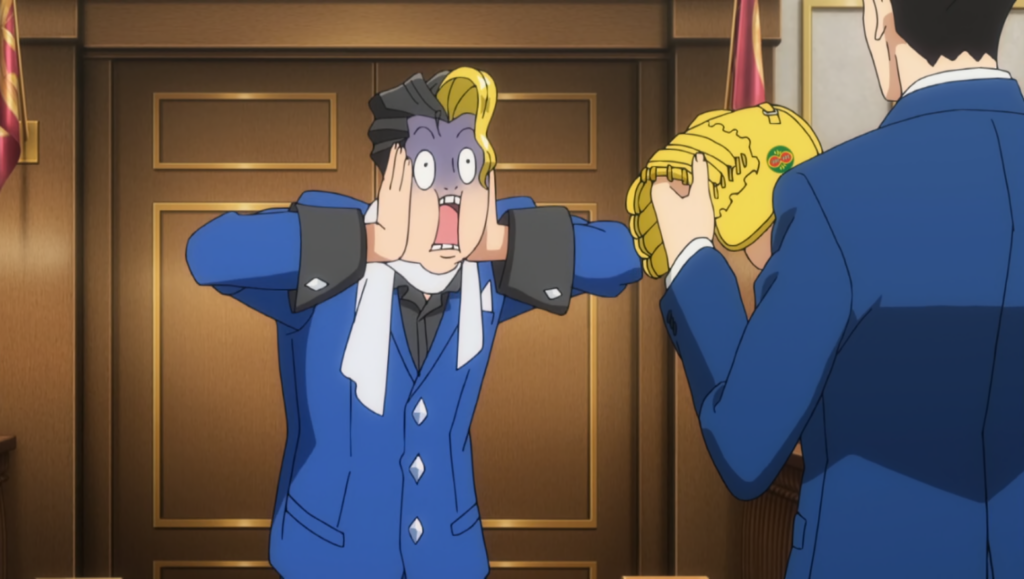
That conceit means these opening cases tend to repeat certain steps such as explaining various mechanics to the player, which are understandable contrivances from the standpoint of this being a video game that must be interacted with in order to proceed. However, these contrivances can also stretch credulity from an in-universe perspective. There’s only so many times the main character can re-learn things they should know off by heart before it becomes laughable.
Some video games choose to ignore this issue and assume you’ll roll with it, like how legendary galactic bounty hunter Samus Aran needs to constantly reacquire the same set of weapons and abilities in every single Metroid. Other games are more concerned with maintaining plausibility, such as Ace Attorney, and so each new opening case has had to come up with some kind of plausible excuse for re-introducing itself to the player.
Most of the sequels have you playing as a new character who hasn’t done much attorneying, or a slightly experienced yet rusty lawyer who’s forgotten a couple things, or placed you in a new situation that both the character and player will need to be guided through. But as the first sequel, Justice For All can only directly follow on from whatever the original game had established and, perhaps aware of that, goes for a goofy premise where main character Phoenix Wright gets clonked on the head by a fire extinguisher and completely forgets what he’s supposed to be doing, slowly recalling his instincts as he bumbles his way through the case.
These are all considerations that apply uniquely to Ace Attorney being an interactive video game, and ones that don’t have as much weight in the medium of the passive cartoon. The viewer doesn’t need to be taught how to be an Ace Attorney for the plot to progress, the show will do that whilst they sit back, maybe speculate about where things will go and otherwise enjoy themselves from afar.
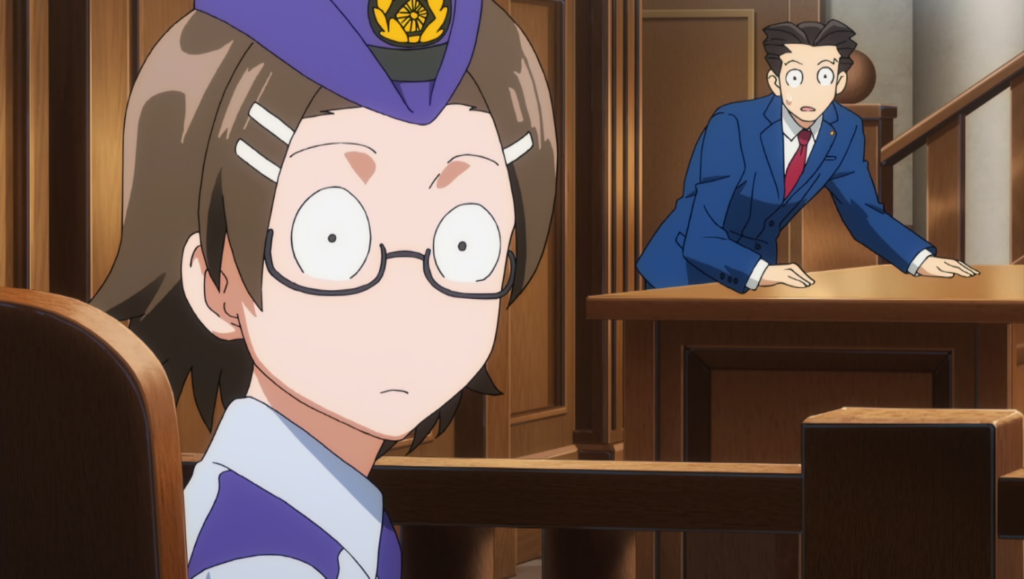
Where this gets interesting, looking at it from the perspective of a television production, is that the first season of Ace Attorney goes straight from adapting the first game to Justice For All, with no break between the two (other than an original episode). There’s no reason to have an episode that reintroduces the premise of the series when it’s still on-going, so the series instead elects to skip to the second case “Reunion, and Turnabout” and carries on from there. This even makes for a smoother chronological flow compared to the games, where “The Lost Turnabout” occurs after the second case in a manner that allows for a shocking character return which can then be elaborated on.
But as mentioned, there was a gap in the production and broadcast between the show’s two seasons, and it’s for the second season that “The Lost Turnabout” is brought back to be used as its opening episode. This allows the episode to re-introduce the concept of Ace Attorney to its audience, whether they’re only tuning in for the first time or haven’t watched the previous season in a while. It accomplishes the same goal as its original game counterpart, but in a way completely unique to it being part of a televised production.
This doesn’t change how the rest of the episode plays out or how I feel about it, my issues with it still stand. But I’m really impressed at the creativity on display here. Even something as small as the placement of an episode broadcast can improve the quality of a show, or at least make you appreciate the craft that goes into making these things, when done right.
Special thanks to Mazinkaiser from the Hardcore Gaming 101 Discord server for proof-reading and providing feedback for the article.
FrDougal9000 writes for hardcoregaming101.net as Apollo Chungus. When he isn’t writing about video games, he is cultivating his love of animation that’s only increased over the last few years as he’s explored the wide, weird and wonderful world of the medium.